
Why we added an LED wall to Influence Studios — and the world it makes possible
What if your next location was already in the studio?
When we decided to add an LED wall to Influence Studios, the goal wasn't to add another piece of technology to the studio. It was to solve a production problem: how do we give clients access to more locations and more visual variety without requiring an entirely different production every time the location changes?
A typical lifestyle shoot can involve an insane amount of logistics. If a shot list calls for a coffee shop, a city street, an architectural setting, a park, an ocean backdrop, and a studio setup, those aren't just six creative ideas. They're six potential locations to find, coordinate, travel to, light, load into, and shoot. Depending on the production, there may also be permits, weather, traffic, parking, company moves, and the simple limitation of how much can realistically fit into one day.
The LED wall gives us another option.
Instead of physically moving the production to every location, we can bring different environments into the studio and shoot the important parts of the scene practically in front of them.
The idea is not to replace practical production
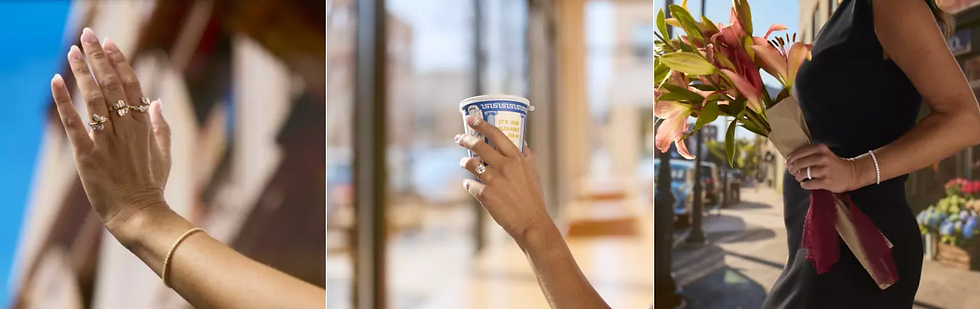
We aren't trying to replace real people, real products, real props, or the physical production process with a digital environment. In fact, the point of the LED wall is almost the opposite. We still want the jewelry to be real. The talent is real. The coffee cup is real. The flowers are real. The props are real.
What changes is the environment behind them.
We can create or source imagery for a location, display that imagery on the LED wall, and then build the physical elements of the scene in front of it. That gives us the ability to combine a practical production with a digital background.
The result is a kind of middle ground between a traditional location shoot and a fully digital production.
You still have a person standing in an actual space, interacting with actual products and props. But instead of spending half the day getting everyone to a coffee shop or trying to find the right city street, the environment can be changed inside the studio.
That opens up considerably more possibilities for what can be accomplished in a single shoot.
A recent jewelry shoot, for example
For a recent jewelry production, the client provided a shot list that included a combination of traditional studio imagery and lifestyle shots. Some of those lifestyle concepts were intended to feel like they were taking place outside of the studio, including New York City-inspired environments.
The client is based in New York, while the production was taking place here in San Diego. We could have approached those shots as a traditional location production, but that would have introduced a significant amount of additional logistics and the production schedule was already very tight.
Instead, we used the LED wall to create those environmental changes within the studio.
We could shoot the jewelry and talent practically while building the scene around them with physical props: coffee cups, flowers, and other details that would exist in the finished image.
The LED wall could then provide the larger environment behind those elements. The same production could move between different visual worlds without moving the entire crew.
The biggest advantage is time
An LED wall doesn't eliminate all of the work involved in creating a scene. You still need to light the subject properly, build the practical elements, position talent and products, and make sure the background and foreground actually look like they belong together.
But changing the environment itself can happen very quickly.
Once the imagery is ready, firing up a new background can take roughly 3-5 minutes. The larger adjustment is making sure the lighting works with the new environment. Once that’s dialed in, the production can move on to the next scene without a location change.
Compare that with physically leaving a studio, driving to a park, finding a place to park, unloading equipment, setting up, shooting, breaking down, and doing it all again at the next location.
During the jewelry shoot, we were working with a particularly tight schedule and the ability to change environments without changing physical locations gave us considerably more flexibility within that window.
The LED wall also changes what a "location" can mean
One of the more interesting possibilities is that we're no longer limited to locations that are physically accessible to the production.
A client might want a New York City environment but be shooting in San Diego. They might want a particular architectural setting, a coffee shop, a specific type of street, or an environment that simply doesn't exist locally.
Instead of asking, "Where can we find this location?" we start asking, "What should this environment look like?"
For example, we can create imagery representing New York streets, coffee shops, buildings, skyscrapers, or other environments and use that imagery as the background for a practical studio shoot. We're also able to use photography and other existing imagery, depending on what the production requires. That gives us significantly more control over the visual world we're creating.
So where does AI come into this?
We are not interested in using generative AI to replace the actual production.
There are still plenty of things that AI-generated imagery struggles with, particularly when you're asking it to create important physical details such as people, hands, teeth, products, or devices. For commercial production, those details matter.
Where we do see value in AI is on the environmental side of production.
AI can be useful for generating backgrounds, developing storyboards, visualizing concepts, and creating imagery that can help us build an environment that would otherwise be difficult or expensive to access.
We're not approaching AI as a replacement for production. We're using it as another production tool. The LED wall is what allows that digital imagery to become part of a physical shoot.
The real value is the combination
A jewelry product can be physically shot with a real model, real coffee cup, real flowers, and real lighting while the LED wall provides the larger environment. The background can be intentionally soft and out of focus while the product remains sharp. Practical elements can interact with the subject. Lighting can be adjusted so that the foreground and background feel like they belong in the same place.
That's what creates the "best of both worlds" approach we're after.
We're still taking photo and video with physical objects and people. We're just giving ourselves considerably more control over the environment surrounding them.
It requires a different kind of production knowledge
An LED wall isn't a shortcut that makes every production automatically easier.
The background imagery needs to be considered carefully. The lighting needs to make sense with what is being displayed. You need to think about how the light from the environment would realistically fall on the talent or product, and then recreate that relationship with your practical lighting.
In other words, you can't just put a picture of a coffee shop on the wall and assume the shot will work.
You have to look at the quality and direction of the light in the generated or photographed environment and figure out how that light should affect the subject in front of it. Once those two pieces match, switching between environments becomes relatively quick.
That's part of what we're continuing to develop at Influence Studios. Our goal is to make the technology increasingly turnkey for clients. Eventually the workflow should be simple: bring us the imagery you want to use, upload it to the system, and get ready to shoot.
We're not quite at the completely plug-and-play stage yet, but we're getting close.
What this means for your next production
The LED wall isn't going to make sense for every shoot.
But if your production requires multiple environments, lifestyle imagery, location changes, or a setting that would be difficult to access in a single day, it gives us another way to approach the problem.
Instead of choosing between a practical studio shoot and a complicated location production, we can combine elements of both.
You bring your talent, products, styling, props, and crew into one controlled studio environment while using the LED wall to create the larger world around them.
That means more locations without traveling to more locations. More visual variety without adding a series of company moves. And more creative possibilities within the same production day.
That's ultimately why we invested in the LED wall - to make more kinds of productions possible.
And we're now making the LED wall available as part of productions at Influence Studios. If you have a shot list that seems like it requires more locations, more travel, or more time than you have, we'd love to talk through what we can build with it.


Comments